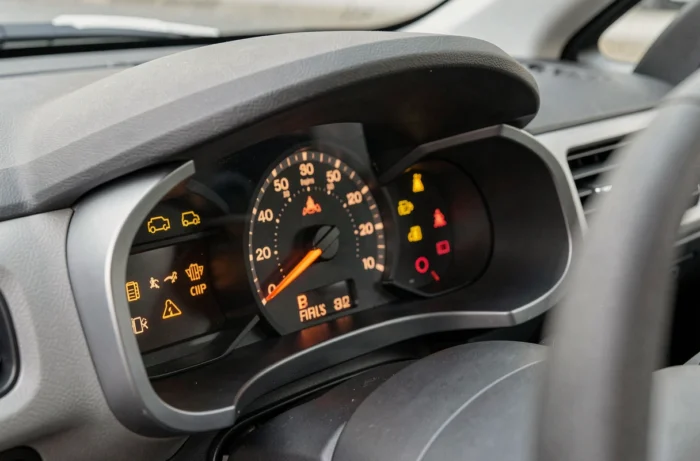
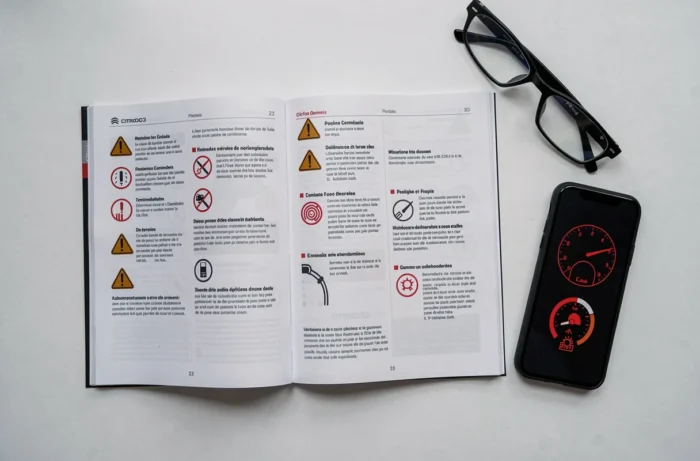
The Citroën C3, across all generations, uses a system of warning lights whose logic has significantly evolved since the early versions. On recent models (from 2024 onwards, including the electric ë-C3), the manufacturer’s manual structures alerts according to a five-level severity scale, ranging from simple information to an order to exit the vehicle. This hierarchy far exceeds the red/orange/green triptych that most online guides present as the only framework for interpretation.
Five-Level Severity Scale on Recent C3s
The manuals for C3s sold since 2024 no longer just associate a color with a degree of urgency. They define five distinct levels: pure information, information accompanied by an audible warning, recommended workshop visit, immediate engine shutdown, and finally, vehicle evacuation. This last level, rarely mentioned in mainstream content, pertains to critical situations such as a major fault in the high-voltage circuit on the ë-C3.
We recommend consulting the manual specific to your production year. The same pictogram (the overheating warning, for example) can trigger a level 3 on a thermal C3 and a level 4 on the electric version, because the consequences on the traction battery differ radically from those on a gasoline engine.
To identify all the warning lights on the Citroën C3 dashboard and their exact meaning according to the engine type, it is necessary to cross-reference the pictogram, its color, and the associated behavior (steady, flashing, accompanied by a beep).
Specific Warning Lights for the ë-C3 Electric

Existing articles frequently mix the warning lights of thermal C3s with those of the electric version. The ë-C3 features warning lights that are absent from the gasoline or diesel variants, and their lack of familiarity leads to unnecessary workshop visits.
- The charging cable connected light prevents any starting as long as the connector is inserted. This is not a malfunction: the vehicle intentionally blocks the powertrain to protect the cable and the socket.
- The turtle mode light indicates a severe power limitation, triggered by a low charge level or an out-of-range battery temperature. The maximum speed then drops drastically, and the air conditioning may be automatically turned off.
- The battery preheating light, active in cold weather, indicates that the thermal management system is conditioning the cells before allowing fast charging. It disappears on its own once the target temperature is reached.
None of these lights exist on thermal C3s. Conversely, the glow plug preheating light (diesel) or the particulate filter light has no equivalent on the ë-C3. Confusing the two universes leads to erroneous diagnostics.
Engine Light and Particulate Filter Light: Two Distinct Diagnostic Logics
The orange engine light (MIL) remains the most frequently illuminated warning on thermal C3s. It signals a fault detected by the ECU, often related to the pollution control system. On diesel engines, it regularly coexists with the particulate filter light, but the two respond to separate mechanisms.
The particulate filter light turns on when the filter reaches a level of clogging that requires regeneration. On the diesel C3, this regeneration is triggered automatically when driving at a stabilized speed for about fifteen minutes. If the vehicle primarily makes short urban trips, the filter never fully regenerates, and the light eventually becomes a permanent alert.
The engine light, on the other hand, stores a fault code that can only be read with an OBD tool. Many drivers confuse the two and attempt a particulate filter regeneration when the problem stems from a faulty differential pressure sensor or an out-of-tolerance lambda sensor. An OBD diagnosis before any intervention avoids unnecessary repairs.
Braking and Driving Assistance Warning Lights on C3
The red brake light covers several very different situations. It activates for a pulled handbrake as well as for an insufficient brake fluid level or a serious hydraulic fault. On the C3, the distinction is made by the behavior of the light: steady at startup (normal self-test), steady while driving (immediate fluid level check), or flashing (system failure requiring a stop).
The orange ABS light indicates a fault in the anti-lock system, but conventional braking remains operational. The ESP light, often represented by a skidding car, flashes when it is actively intervening (slippery turn, emergency braking) and stays on steadily when the system is manually disabled or in fault.
On recent C3s equipped with driving assistance features (lane departure warning, automatic emergency braking), additional lights appear. Their voluntary deactivation via the instrument cluster menu lights up a dedicated warning, which does not indicate a fault but a driver choice. This point regularly generates confusion.
Maintenance Lights and Wrench Light
The orange wrench light on the C3 is not a fault signal. It indicates that the scheduled maintenance deadline is approaching or has been exceeded. The ECU bases this on mileage and the time since the last reset, not on the actual condition of the parts.
After a service, the maintenance counter must be manually reset via the procedure described in the manual (button combination on the instrument cluster). If this reset is not performed, the light remains on even if maintenance has been carried out. A persistent wrench light after a service indicates a reset oversight, not a mechanical fault.
The oil level and oil pressure lights, although visually similar (oil can pictogram), do not have the same severity. The first is orange and allows time to top up the level. The second, red, requires an immediate engine shutdown to avoid mechanical failure. On the C3, these two lights coexist, and confusing them can cost an engine.