
On an urban journey with the Citroën C3, you eventually get to know the scenario: the car radio cuts off, the ventilation goes into standby, and the dashboard displays “energy-saving mode.” The vehicle limits its comfort features to protect the 12 V battery. While this conservation logic makes sense in case of low voltage, it quickly becomes annoying when it triggers repeatedly, sometimes even after just a few minutes of driving.
Understanding what causes this reduction and knowing how to respond allows for a return to normal use without risking disrupting the electronics.
Battery Voltage and ECU: What Really Triggers Eco Mode on the C3
The energy-saving mode of the Citroën C3 is not a setting that is intentionally activated. It is a protection controlled by the vehicle’s ECU. When the voltage of the 12 V battery drops below a critical threshold, the system cuts off or reduces the power supply to secondary consumers: car radio, USB ports, ventilation, and sometimes even interior lighting.
Several situations can cause this voltage drop. Short repeated trips, typical of city driving, do not allow the alternator enough time to properly recharge the battery. An aging battery, whose storage capacity has decreased, reaches the alert threshold more quickly. Energy-hungry accessories (heated seats, GPS, phone charger) accelerate the phenomenon.
Owner feedback on specialized forums indicates that on newer C3 models, eco mode tends to trigger earlier, sometimes even with a battery in good condition. The ECU applies wide safety margins to prevent a voltage drop that would prevent starting.
Before attempting to deactivate anything, one should first check the actual condition of the battery. A simple load test at a garage or with a multimeter (voltage at rest above the nominal threshold) can determine whether the problem lies with the battery itself or with the system being too sensitive.
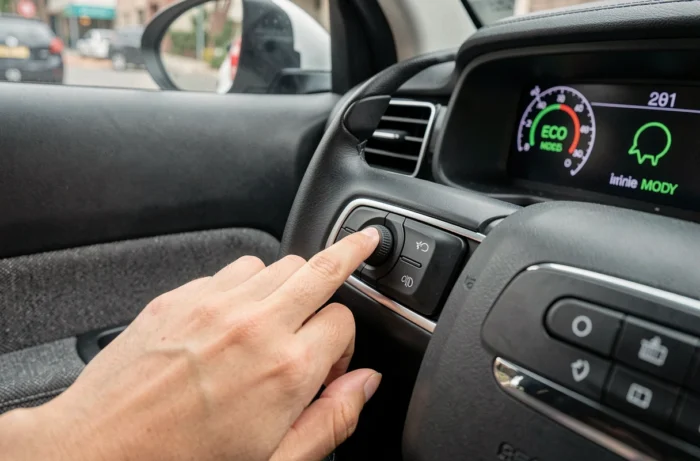
Concrete Method to Deactivate Eco Mode on the Citroën C3
When looking to remove eco mode from the Citroën C3, the first thing to understand is that there is no dedicated button on all versions. The procedure depends on the generation of the vehicle and the type of engine.
On C3s Equipped with Stop and Start
The “ECO OFF” or “Stop&Start OFF” button, located on the central console, allows you to temporarily deactivate the stop and start system. A single press is enough. The indicator lights up on the dashboard to confirm deactivation. This action must be repeated at each engine start, as the system automatically reactivates when the ignition is turned off.
When the “energy-saving mode” message Persists
If the message remains displayed despite deactivating stop and start, the problem is different. The ECU has detected insufficient voltage and maintains the limitation of consumers. In this case, the procedure involves a more in-depth diagnosis:
- Test the 12 V battery (residual capacity and voltage under load). A battery that shows a correct voltage at rest can collapse under load.
- Check the condition of the alternator. A tired alternator no longer provides enough current to recharge the battery while driving, especially at low revs in the city.
- Inspect the battery terminals. Oxidation on the terminals is enough to create resistance that skews the voltage reading by the ECU.
- If the battery is over four years old, replacing it resolves most of the unexpected triggers of eco mode.
After a battery change, some models require a recalibration of the ECU via the diagnostic port. Without this step, the system continues to rely on the old parameters of the replaced battery and may keep eco mode activated for no reason.
Comfort vs. Emissions: The Limits to Know Before Modifying Settings
Temporarily deactivating stop and start via the button provided by Citroën poses no technical or legal issues. The function exists precisely for that. Things get complicated when seeking a permanent deactivation, for example via an electronic box or ECU reprogramming.
In several European countries, particularly Germany, a permanent deactivation of the stop and start system may be considered a non-compliant modification of the vehicle. The risk: a loss of technical approval during inspection, on the grounds that the measured emissions no longer correspond to the original homologation. In France, feedback varies on this point, but the technical inspection evaluates emission levels, and any measurable degradation can lead to a re-inspection.
From a mechanical standpoint, keeping stop and start active does not wear out the starter faster than expected. C3s equipped with this technology have a reinforced starter designed to withstand a number of cycles far exceeding that of a conventional starter. Deactivating the system “to protect the starter” has no real technical basis on these engines.
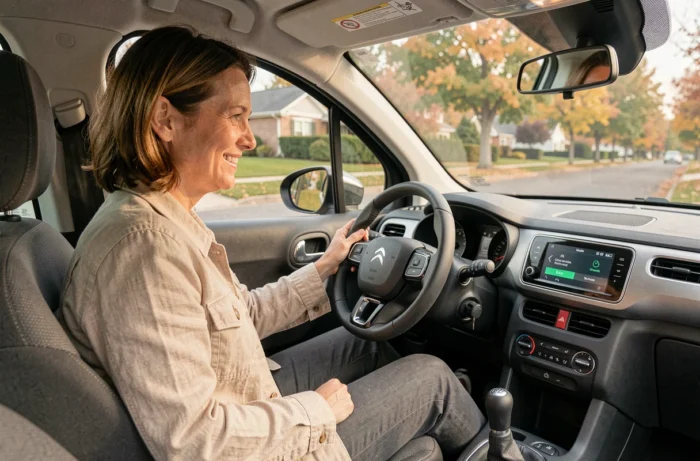
12 V Battery of the Citroën C3: Choosing the Right Replacement
When eco mode returns after each stop despite a functional alternator, the battery is almost always to blame. On the C3, the choice of replacement model directly impacts the frequency of triggers.
- C3s with stop and start require an AGM or EFB type battery, capable of withstanding frequent discharge/recharge cycles. Installing a conventional lead battery causes premature triggers of eco mode.
- The capacity (expressed in Ah) must match the original specifications. Installing a battery with a lower capacity “because it fits in the compartment” guarantees recurring problems.
- After installation, a diagnostic check to register the new battery in the ECU prevents the system from retaining the thresholds of the old one.
A well-executed replacement, with the correct type of battery and recalibration, is sufficient in the vast majority of cases to eliminate unexpected appearances of energy-saving mode. Driving comfort returns to normal, without electronic hacks or modifications that could pose problems at the next technical inspection.