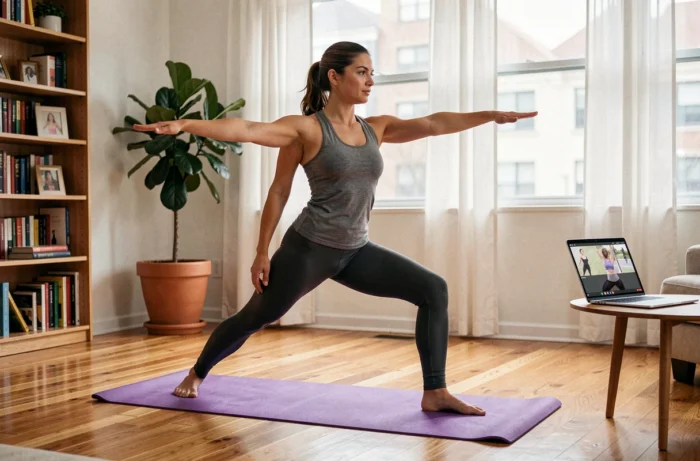
When you get home from work at 7:30 PM, the gym closes at 9 PM, and you still need to prepare dinner, the window for exercising shrinks to almost nothing. It is precisely in this tight timeframe that online sports activities make perfect sense. With a mat, a two-square-meter space, and a screen, you can fit in a structured session without travel time or scheduling constraints.
Live session or replay: two training logics for home
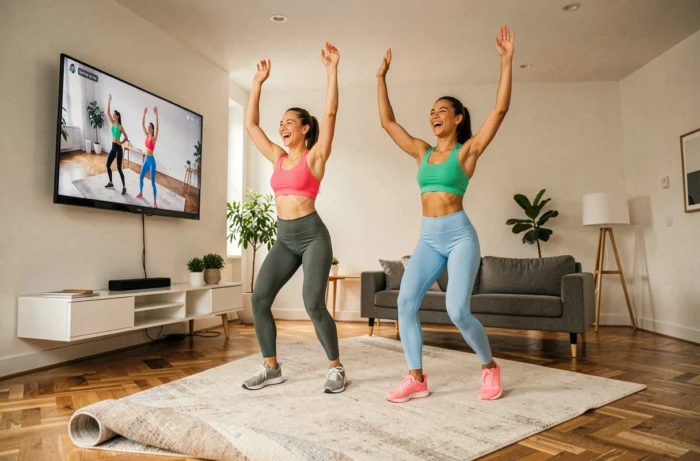
The first question to decide before choosing an online class is the format. A live class imposes a fixed schedule, but it creates an appointment effect that helps maintain consistency. Urban Sports Club, for example, offers live online classes accessible from home, with a coach providing real-time corrections via the camera.
The replay, on the other hand, offers total flexibility. You can start the video at 6 AM or 10 PM, pause it, or redo a poorly executed movement. Feedback varies on this point: some people lose motivation without the social pressure of a live session, while others find the replay more suited to an unpredictable schedule.
For those who want to explore a wide range of disciplines from their living room, you can access Sport en Ligne and check the different practices available according to your level and goals.
Individualized progression: what distinguishes a good online program
The majority of competing articles list exercises or disciplines. The real issue is progression. A bodyweight squat becomes less effective after three weeks if you don’t change the tempo, load, or range of motion.
Recent coaching apps incorporate this logic. Azeoo, for example, structures its programs with variations based on level, a precise tempo, and controlled time under tension. You progress from an isometric squat to a Bulgarian squat, then to an assisted pistol squat, with a planned increase in difficulty over several weeks.
This approach changes the game compared to a simple YouTube playlist. You don’t pick an exercise at random: you follow a progression scheme that targets the same muscle groups in an increasing manner, with recovery phases integrated between sessions targeting the same areas.
Movement patterns rather than isolated muscles
The latest online programs no longer divide the week into “arm day” and “leg day.” They organize sessions by complete movement patterns: push, pull, rotation, locomotion. You work the body as a functional whole, which reduces the risk of muscular imbalance common among isolated practitioners.
Specifically, a typical session might include push-ups (push), pull-ups on a door frame (pull), and lunges with torso rotation (locomotion and rotation). The goal is not to “do cardio” or “do strength training,” but to cover all axes of movement throughout the week.
Online fitness without equipment: the minimum that really works
It is often said that you need to invest in dumbbells, resistance bands, and an adjustable bench. In reality, a mat, a timer, and about two square meters are enough to start an effective workout at home. The Fitness Club confirms this minimalist approach.
Additional equipment only becomes useful when bodyweight is no longer sufficient to generate progressive overload. For most beginners and intermediates, bodyweight exercises adequately meet needs for several months.
- A timer (free app on your phone) to structure effort and rest times, which helps avoid unconsciously shortening breaks or rushing the last repetitions.
- A dedicated workout playlist, because music alters the perception of effort and helps maintain a steady pace during long sets.
- A dedicated space, even small, that you don’t dismantle between sessions. Leaving the mat unrolled reduces mental friction when starting.
Adjusting intensity without equipment
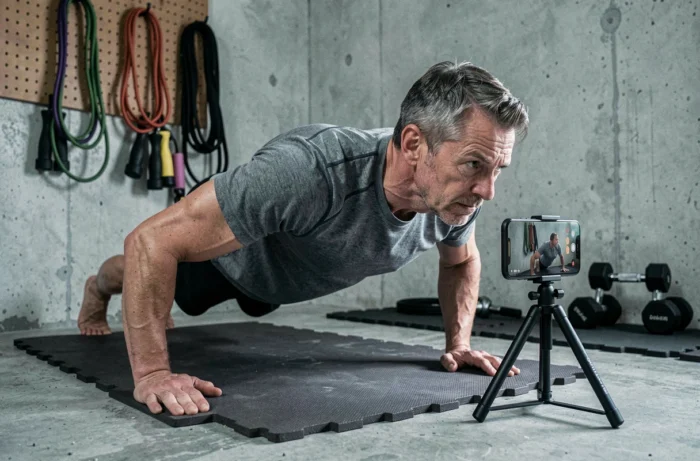
When classic push-ups become too easy, you don’t necessarily add weight. You can slow down the descending phase to four seconds, pause at the bottom of the movement, or switch to a one-handed variation. The tempo and isometric pauses replace the load when training without equipment.
The same logic applies to squats, lunges, and pull-ups. Changing the angle, speed, or range of motion is enough to restart progression without buying anything.
Online yoga and gentle gymnastics: for whom and how often
Yoga and gentle gymnastics are not reserved for recovery days. These disciplines work on joint mobility, proprioception, and deep core stability, three components often neglected by traditional strength training.
Integrating one to two yoga sessions per week into a fitness-oriented program improves movement quality in other sessions. You gain range in squats, reduce shoulder tension after push-ups, and prevent lower back pain related to prolonged sitting.
- Pilates targets the deep abdominal belt and corrects postural imbalances, making it a direct complement to strength training.
- Active stretching, practiced at the end of a session, maintains flexibility without compromising muscle performance for the next day.
- Dynamic yoga (vinyasa) combines moderate cardio work and mobility, useful when you want to move without stressing the same muscles as the day before.
These formats are widely available in online classes, either free or by subscription, on video platforms or dedicated fitness coaching apps.
Maintaining regular physical activity at home requires neither a gym, expensive equipment, nor two hours of availability. The challenge lies in the structure of the program and the ability to gradually increase difficulty. A well-organized workout on a living room mat produces results comparable to a gym session, provided you respect the logic of progression and allow the body time to recover between demands.