
The dematerialization of public and private services has made the use of the internet almost mandatory for managing daily life. For elderly individuals who did not grow up with these tools, this transition creates real difficulties: online tax declaration, scheduling medical appointments, tracking retirement files. Several types of devices coexist in France to meet these needs, but their scope, access conditions, and effectiveness vary considerably.
Aidants Connect and secure delegation of online procedures
The digital support for seniors is no longer limited to learning. In recent years, a shift has occurred towards carrying out procedures on behalf of the user, within a defined and secure framework.
The Aidants Connect system illustrates this change. It allows authorized professional caregivers to act on behalf of a person via a mandate, with FranceConnect login and complete traceability. The areas covered include health, family, employment, retirement, and taxes.
One less visible limitation deserves to be noted: family and volunteer caregivers cannot be authorized. Only employees of eligible structures (France Services spaces, CCAS, associations, social centers) have access to the tool. For a senior whose surroundings are the main digital relay, this restriction reduces the reach of the system. Among the services offered by seniorcybernet.org, there is support that attempts to fill this type of gap by addressing isolated users directly.
At-home digital support for isolated seniors
Traveling to a France Services space or a social center requires mobility that not all seniors possess. Loss of autonomy related to age, disability, geographical distance: these barriers keep part of the public out of reach of collective devices.
Some associations have developed digital support programs directly at the homes of elderly individuals. The principle relies on volunteers who visit seniors to help them get to grips with their devices.
The home is a particularly suitable lever because it allows working on the person’s actual device, in their usual environment, with their own identifiers and applications. Field feedback varies on the time needed to achieve stable autonomy: some seniors gain confidence after a few sessions, while others require prolonged follow-up.
What at-home support concretely covers
- Getting to know the personal tablet or smartphone, with configuration of access to the services used (messaging, health, taxes)
- Learning recurring actions: sending a message, making a video call, consulting an administrative document
- A relational aspect that goes beyond the technical, as the regular visit of a volunteer helps break social isolation
Cybersecurity for seniors: a blind spot in traditional training
Most digital initiation programs focus on using the device: navigating a site, creating an account, using an application. The issue of online security is often treated superficially or even ignored.
However, seniors are a prime target for phishing attempts. A fraudulent email imitating an official organization, a text message asking to “confirm” bank details: these situations require reflexes that traditional initiation does not build.
Specialized cybersecurity workshops now offer ongoing support rather than a one-time awareness session. This iterative format allows revisiting mistakes, simulating real situations, and anchoring good reflexes: checking the sender, never clicking on a suspicious link, managing passwords methodically.
Three digital security skills to prioritize
- Phishing detection: identifying signs of a fraudulent message (inconsistent address, artificial urgency, syntax errors)
- Password management: creating distinct passwords for each service, understanding the benefits of a dedicated manager
- Two-factor authentication: activating this protection on sensitive accounts (messaging, banking, taxes) and knowing how to use it daily
France Services digital advisors: coverage and limits of territorial networks
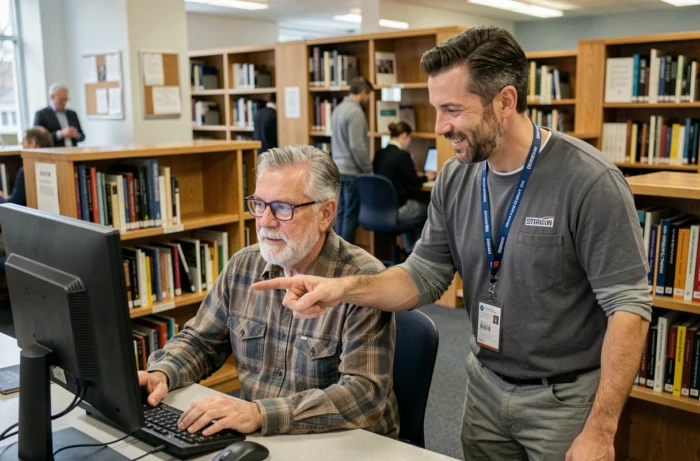
The deployment of digital advisors across the French territory aims to provide a local point of contact. These professionals operate in France Services spaces, libraries, town halls, and certain associative structures.
Their mission includes assisting with online administrative procedures and initiating users into digital tools. In practice, availability varies greatly by region. Rural areas and small municipalities sometimes have only one advisor for a large population, which extends appointment waiting times.
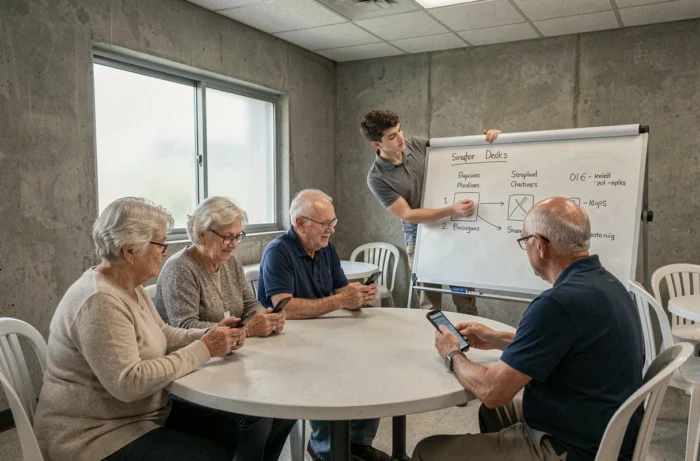
The format offered oscillates between collective workshops and individual support. Collective workshops are suitable for those with some background but pose problems for those starting from scratch. Individual support, more effective for complete beginners, requires more time and is therefore limited in volume.
The available data do not allow conclusions about the long-term impact of these devices on the actual digital autonomy of seniors. Occasional support solves an immediate problem (filling out a declaration, creating an email address), but the question of consolidating skills between appointments remains open.
The digital support offer for seniors in France combines institutional, associative, and volunteer devices, each with its strengths and blind spots. Aidants Connect secures delegation but excludes close relatives. At-home support reaches the most isolated but depends on the availability of volunteers.
Cybersecurity remains the neglected aspect of most programs. Before choosing a service, the first question to ask is less about the tool than about the real need: to learn to do it oneself, or to find someone trustworthy to do it for them.