
Fleece and cashmere insulate through distinct mechanisms, and comparing them solely on the criterion of “warmth” leads to shortcuts. A comparative study published in 2024 on textile insulators confirms that thermal performance depends more on the density and construction of the fabric than on the nature of the fiber itself. In other words, a thick, tightly woven fleece can outperform a poorly constructed fine cashmere.
Thermal conductivity and air trapping: fleece vs cashmere
Cashmere earns its reputation from the fineness of its fibers, which are significantly finer than those of regular wool. This fineness allows for a tight weave that traps small pockets of still air, the main vector of thermal insulation in a textile. At the same weight, a dense cashmere knit offers an impressive warmth-to-weight ratio.
Fleece works differently. Made from textured polyester, it creates a looped or brushed surface that traps air within its thickness. Insulation comes from the volume of the structure, not from the fineness of the fiber.
We observe that mainstream articles compare these two materials as if they belong in the same category. In reality, the differences in warmth between fleece and cashmere are as much about construction as they are about the raw fiber. A tightly knitted two-ply cashmere will outperform a cheap fine fleece, but a high-density fleece will compete with mid-range cashmere.

Moisture management and warmth in real conditions
Static warmth, measured in a lab, tells only part of the story. In real winter conditions, sweat and ambient humidity radically change a garment’s behavior.
Fleece dries quickly and retains its insulating properties even when wet. This is its main advantage when hiking, cycling, or during any physical effort that generates sweat. Polyester is hydrophobic: it does not absorb water and expels it to the surface, where it evaporates.
Cashmere, an animal fiber, absorbs moisture before feeling wet to the touch. This hygroscopic ability allows it to regulate body temperature indoors or during sedentary activities. In contrast, a cashmere sweater soaked with sweat takes significantly longer to dry than a fleece, and loses some of its insulating power during this time.
- For urban or office use, cashmere remains more effective due to its natural thermoregulation and comfort against the skin.
- For outdoor activities (cross-country skiing, brisk walking, cycling), fleece offers quick drying and warmth retention under exertion.
- In rainy weather without a windproof layer, neither material protects effectively: without wind protection, insulation drops significantly regardless of the textile.
Layering system: fleece and cashmere in winter layering
Comparing fleece and cashmere outside the context of layering doesn’t make much practical sense. A sweater, whether made of cashmere or fleece, is just an intermediate layer in a winter clothing system.
Fleece excels as a technical mid-layer under a windproof jacket or waterproof coat. Its lightweight, compressibility, and quick drying make it the logical choice for a three-layer system (thermal base layer, fleece, outer shell).
Cashmere is positioned differently. Worn as a single layer under a wool coat, it increases warmth without bulk. Its fineness allows for discreet stacking, whereas a thick fleece adds visible volume under a fitted jacket. For a city coat, a tightly knitted cashmere sweater will be more suitable than a fleece that creates bulk.
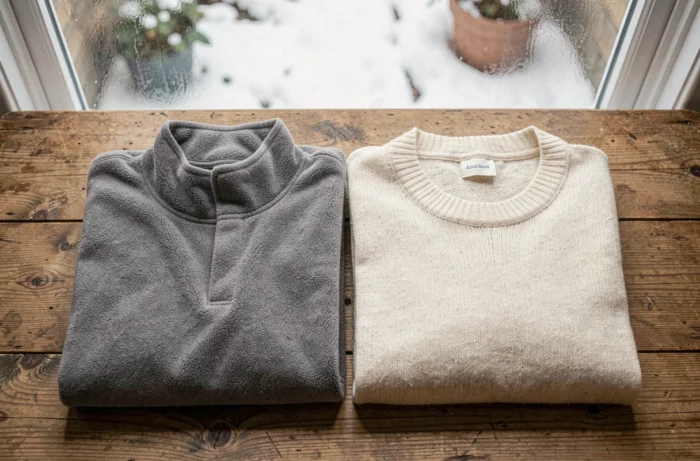
The issue of weight
We recommend never comparing a fleece and a cashmere without checking the weight. A lightweight fleece designed as a base layer will not compete with a thick two-ply cashmere. Conversely, a high-density fleece will surpass a fine cashmere in pure insulation. The weight and density of the knit determine warmth, not the label “cashmere” or “fleece” alone.
Durability and maintenance: impact on thermal performance over time
A often overlooked parameter is the evolution of insulating capacity over the course of washes and wear.
Fleece pills quickly, especially entry-level ranges. This pilling compresses the surface fibers, reduces the volume of trapped air, and gradually decreases insulation. After several dozen washes, a cheap fleece can lose a significant portion of its initial performance. Anti-pilling fleeces (like Polartec) resist better, but their price then approaches that of some cashmeres.
Cashmere, when well maintained (hand wash, flat drying), retains its properties longer. The long, fine fibers keep their cellular structure. A quality cashmere worn and washed correctly maintains its warmth over several seasons. A poorly treated cashmere (tumble dryer, aggressive machine wash) felts, loses its loft, and its insulating power.
- Fleece: estimated thermal lifespan of a few seasons for standard ranges, longer for technical ranges.
- Cashmere: longer lifespan if maintenance is rigorous, but sensitivity to felting and moths.
- In both cases, inadequate maintenance degrades warmth faster than normal wear.
Fleece or cashmere for winter: selection criteria based on use
The choice between fleece and cashmere is not just about “warmer” or “less warm.” It is about the context of use. For ski or hiking clothing, technical fleece remains the rational choice: lightweight, quick drying, moisture resistance. For a sweater worn daily in the city under a coat, cashmere offers better static thermal comfort and an unmatched touch.
Budget also comes into play: a high-end technical fleece can sometimes cost as much as decent cashmere, which puts into perspective the economic argument often made in favor of synthetic materials. The best winter insulator is the one that matches your activity and layering system, not the one with the most prestigious name on the label.