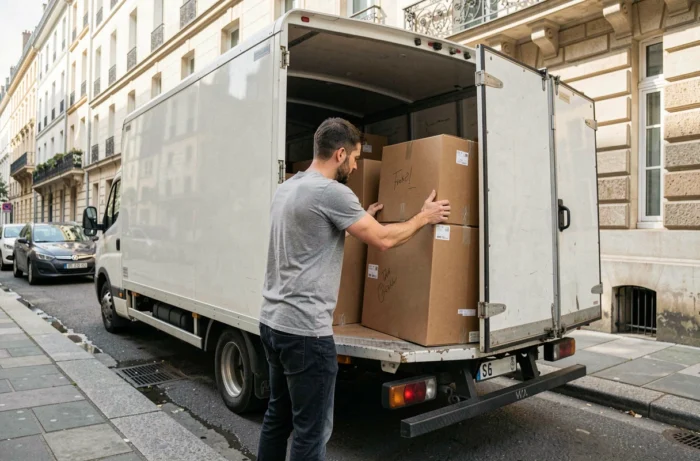
Moving with a truck found on BlaBlaCar means taking advantage of a journey already planned by a driver to slip in boxes and furniture. The principle is based on cost-sharing: the driver does not charge for a transport service, they divide their road costs. This legal nuance changes everything, both in terms of price and the guarantees you have.
Cost-sharing and legal limits of transport via BlaBlaCar
The legal framework for carpooling in France imposes a simple rule: the driver cannot make a profit from the trip. They only share fuel and toll costs. If the amount requested exceeds these actual costs, the operation shifts into paid transport, subject to strict professional regulations.
In practice, an individual offering to transport your belongings in their van via BlaBlaCar is not a mover. They have neither a transport license nor professional insurance covering your goods. In case of damage or loss, no contractual guarantee automatically applies.
This point is often underestimated. Before loading an antique dresser or a fragile screen, check your own home insurance. Some contracts cover goods in transit during a move, while others do not. A call to your insurer before the big day avoids unpleasant surprises.
Organizing a move with a BlaBlaCar truck therefore requires a good understanding of this framework: you benefit from a very low rate, but you assume a share of the risk that only a professional mover would otherwise cover.
Finding a truck on BlaBlaCar: concrete search method
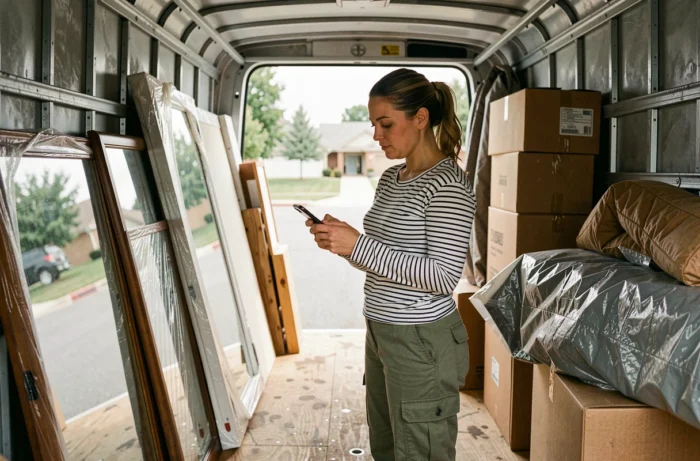
BlaBlaCar does not have a “truck” or “utility” filter in its search engine. The platform is designed for passenger carpooling. Therefore, you need to adapt your approach.
Spotting drivers with a large vehicle
Start by searching for your trip on the desired dates. Browse the profiles of drivers: some specify the type of vehicle (van, station wagon, minivan). Contact directly those who drive a utility or spacious vehicle to propose transporting your belongings instead of a passenger.
Also post an ad on forums and specialized groups in co-transportation. Dedicated platforms for co-transporting exist alongside BlaBlaCar and can complement your search.
The rise in fuel prices works in your favor
The recent increase in gasoline prices has prompted more drivers to register on BlaBlaCar to offset their costs. This dynamic increases the number of long-distance trips offered, including by owners of vans or small trucks. You therefore statistically have a better chance of finding a suitable vehicle than a few years ago.
Preparing your belongings for non-professional transport
A BlaBlaCar driver has no professional straps, no protective blankets, and no hand truck. All packing and cushioning materials are your responsibility.
- Wrap each fragile piece of furniture with thick blankets or bubble wrap, then secure everything with wide adhesive tape. An unprotected mirror or screen will not survive the vibrations of the road.
- Use sturdy, closed boxes labeled by room. Open boxes slide and crush, especially in a van without partition walls.
- Plan to use ratchet straps to secure heavy loads to the floor or walls of the vehicle. Without securing, a 40 kg piece of furniture becomes a projectile at the first sudden stop.
- Weigh your belongings before loading. The driver must respect the maximum payload of their vehicle, indicated on the registration document.
Arriving at the meeting point with your belongings ready to load also shows respect for the driver, who is helping you on their own trip.
Real cost of a move in co-transportation versus rental
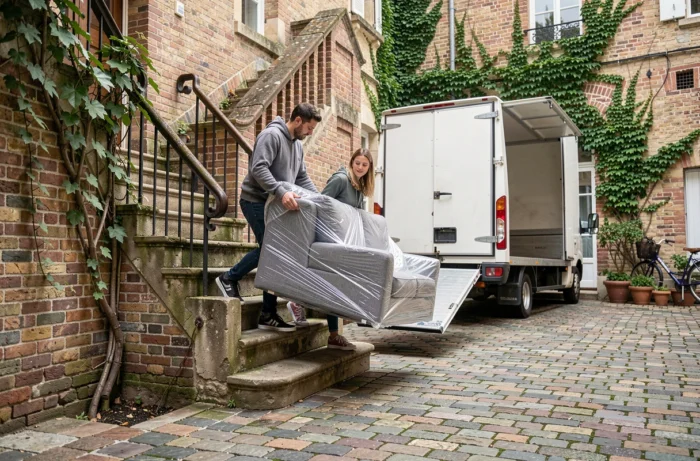
Why does this mode of transport attract so much? The price. Co-transportation costs a fraction of the price of a professional mover, and often less than renting a truck with fuel and tolls.
With a traditional mover, you pay for labor, cargo insurance, the vehicle, and the company’s overhead. When renting a utility vehicle, you pay the daily rental, mileage, fuel, and tolls, plus the rental company’s additional insurance.
In co-transportation via BlaBlaCar, you only participate in sharing the driver’s road costs. For a trip of several hundred kilometers, the price difference can be considerable.
The trade-off is flexibility. You depend on the driver’s dates and times, not your own. And the transportable volume remains limited to the available space in their vehicle, after their own belongings if applicable.
When co-transportation makes sense
This mode of transport is suitable for partial moves or small volumes: a studio, a few second-hand furniture pieces bought from afar, boxes to send between two cities. For a complete apartment with appliances, renting a dedicated truck remains more realistic.
Insurance and liability: what to check before the trip
The individual driver has their auto insurance, which covers bodily injury and property damage related to a road accident. However, the goods transported for a third party are generally not covered by this insurance.
- Ask the driver to confirm that their auto policy does not have an exclusion for transporting goods for others.
- Check with your insurer if your multi-risk home insurance covers your belongings during a move, including in a third party’s vehicle.
- Photograph each valuable item before loading. In case of dispute, these photos serve as proof of the initial condition.
A written agreement between you and the driver (even a simple message exchanged on the platform) specifying the nature of the goods, the amount of cost-sharing, and the transport conditions strengthens your position in case of a problem.
Shared moving via BlaBlaCar remains a pragmatic solution for small volumes and tight budgets. The key lies in two words: preparation and transparency with the driver. A well-negotiated trip, properly packed belongings, and verified insurance are enough to turn a simple carpool into a successful move.