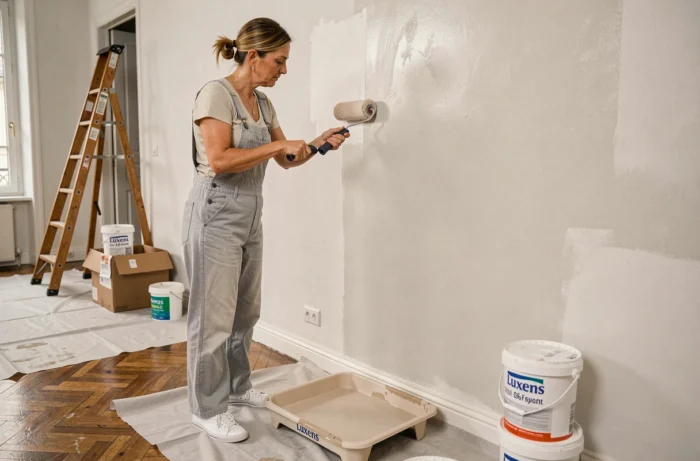
Luxens is the private label brand of Leroy Merlin, present in almost all of its paint sections. Its pricing positioning makes it a recurring choice for individuals who are renovating their interiors or facades themselves. Feedback from users varies on this point: some find it sufficient for regular work, while others report disappointing results on demanding projects. Behind the unique label “Luxens” are actually references with very different technical characteristics.
Luxens Washability Class: A Technical Data Often Ignored
The first common mistake is to refer to “Luxens paint” as a homogeneous product. The technical data sheets available reveal significant discrepancies from one reference to another.
A standard Luxens wall paint is classified in class 2 according to ISO 11998, which corresponds to a reasonable wash resistance for living spaces. A white reference in a 14-liter can is rated class 1, the most resistant to cleaning. In contrast, the anti-mold XXL version drops to class 3 and beyond, with cleaning limited to a non-abrasive sponge or a damp cloth.
This disparity means that a buyer relying on online reviews without checking the washability class of the specific reference they are purchasing risks getting a result very far from their expectations. Several reviews collected from analyses published on the Immo et Habitat site confirm this variability across ranges.
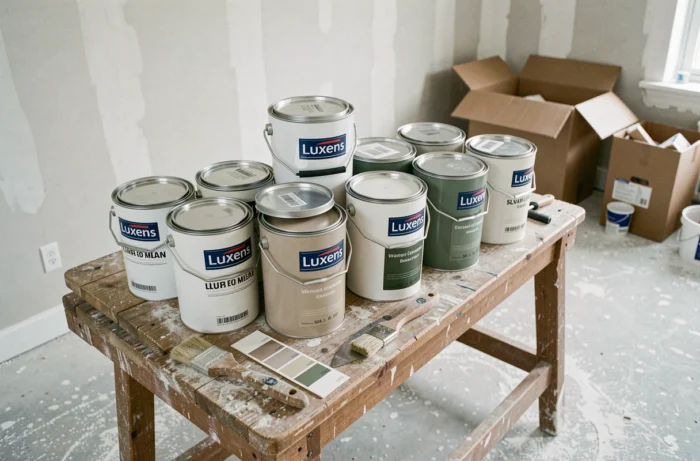
Drying Time Between Coats: A Parameter That Affects Project Duration
On a renovation site, the time between two coats determines the schedule as much as the number of coats themselves. Recent data sheets for several Luxens wall paints indicate a delay of 4 to 8 hours between coats. The anti-mold XXL version, however, only requires 2 hours.
For an individual painting over the weekend, this difference is not trivial. With an 8-hour drying time, applying two coats in the same day becomes impossible unless starting very early. Conversely, the quick-drying reference allows for completing a room in one day.
User feedback varies on the final finish when respecting the indicated minimum time. Some users report satisfactory results by strictly adhering to the 4 hours, while others prefer to wait a full night to avoid visible touch-up marks in low light.
European Eco-Label and Emissions: No Single Answer on the Luxens Range
The mention “water-based paint” appears on the majority of Luxens cans, which may give the impression of a product that is consistently environmentally friendly. The reality is more nuanced.
- Some Luxens wall references display an indoor air emission rated A+ and carry the European Eco-Label, which guarantees an environmental specification verified by a third-party organization.
- The anti-mold XXL paint consulted indicates that no ecological certification is applicable to this reference, despite its water base.
- The Aquaeo Luxens aerosols also display an A+ rating, but their spray format involves usage conditions (ventilation, projection distance) that limit direct comparison with a standard can.
A buyer concerned about indoor air quality after work must therefore check for the presence of the Eco-Label on each can individually, and not rely on the brand’s overall marketing positioning.
Finish and Appearance: What User Reviews Reveal
DIY forums and specialized groups highlight a recurring pattern. In matte or satin finishes on white walls and ceilings, Luxens delivers results deemed acceptable for regular work, provided that an appropriate primer is applied and the recommended number of coats is respected.
The most severe criticisms concern two specific situations:
- Application on exposed exterior surfaces, where users have reported darkening or premature peeling on certain older references.
- The covering power in a single coat, often deemed insufficient compared to mid-range or premium brands like Tollens or Zolpan, which necessitates multiple applications and reduces the initial price advantage.
- The durability in humid areas (bathrooms, kitchens), where references not specifically formulated for these environments show their limitations.

Luxens vs. Competing Brands: Price Is Not Everything
Luxens’ pricing positioning is at the entry level, placing it in direct competition with brands like Colors (also distributed by Leroy Merlin) or certain references from V33 and Ripolin sold in DIY stores.
The price per liter argument works in favor of Luxens for large surfaces: repainting an entire apartment in white costs significantly less than with professional paint. However, the actual cost depends on the number of coats required. If a standard Luxens paint requires three coats where a Tollens requires two, the price difference narrows, and the working time increases.
The available data do not allow for a general conclusion about the superiority of one brand over another. The result depends on the specific reference, the substrate, the preparation, and the application conditions. A well-prepared wall with a proper primer and a Luxens class 1 will yield a more durable result than a poorly sanded wall covered with a premium paint.
What Use for Which Luxens Reference
For interior renovation work on walls and ceilings in good condition, Luxens references rated in class 1 or 2 represent a rational choice. For humid rooms or exterior facades, user feedback encourages prioritizing ranges specifically formulated for these conditions, even if it means increasing the budget.
The Luxens brand is neither a bad choice nor a universal one. Each reference must be evaluated based on its own technical data sheet, not on the name printed on the can.