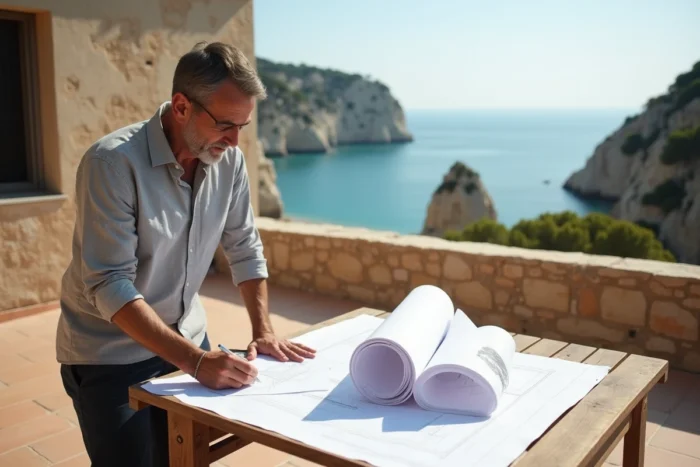
Building a villa in Cassis involves a constant tension between the expected level of service and the reality of costs in the PACA region. The prices for new construction in Bouches-du-Rhône range between 1,500 and 2,200 euros per square meter excluding taxes for a standard level compliant with RE2020. They rise to between 2,200 and 2,800 euros per square meter as soon as a pool and high-end finishes are included.
In this context, the role of the project manager goes beyond simple site coordination: they become the guarantor of a budget that can drift with each technical decision.
Wood-concrete block gap in Cassis: a structural choice that impacts the villa budget
The choice of construction method is the first area where the budget is determined, and feedback from the field varies on this point depending on local companies. A standard wooden frame villa costs significantly more than a traditional concrete block construction, with a gap that can reach several hundred euros per square meter.
This additional cost is not limited to the raw material. The wooden frame requires specific skills that not all craftsmen in the Cassis area possess, which reduces the competition for quotes. A villa construction project manager in Cassis who knows the local fabric can identify the lots where wood generates a disproportionate additional cost compared to the actual thermal gain.
On the other hand, the wooden frame can shorten the construction duration by several weeks, which reduces follow-up costs and weather-related risks on a coastal site. This overall calculation must be established before committing to a construction method.
A common trap: choosing wood for aesthetic reasons without having calculated the impact on the total envelope. A competent project manager presents a structured comparison, lot by lot, before submitting the building permit.

Project manager fees and work budget: understanding the real mechanics
The fees of a project manager represent a percentage of the total cost of the work, generally within a wide range. This mode of remuneration creates a paradox that few project owners anticipate: the more expensive the project, the more the project manager is paid.
This mechanism is not necessarily a problem if the contract includes safeguards. The point to verify before signing:
- Is the fee calculation base the initial estimated amount or the actual amount of the work after adjustments? The difference can represent several thousand euros on a villa in Cassis.
- Does the contract provide for a cap on fees in case of budget overruns, or does the project manager benefit mechanically from every additional cost?
- Are technical studies (soil study, structural engineering office, RE2020 thermal engineer) included in the fees or billed separately?
A well-drafted contract aligns the interests of the project manager with those of the project owner. Without this clause, the professional has no financial incentive to contain expenses. The available data does not allow for a conclusion that one mode of remuneration (fixed fee, percentage, mixed) is systematically more advantageous than another: it all depends on the complexity of the project and the level of oversight expected.
BT01 index and price revision: the risk that quotes do not mention
On a villa project that spans ten to fifteen months, the prices of materials and labor evolve. The BT01 index measures this evolution for the construction sector. A price revision clause indexed to the BT01 can vary the final cost by several percentage points without any program changes being requested.
The project manager intervenes here at two levels. First, during the drafting of contracts with craftsmen: they can negotiate fixed prices on certain short lots (electricity, plumbing) and only accept revisions on long lots (structural work, roofing). Then, during the financial monitoring of the project: they ensure that the revisions applied correspond to the indices actually published, and not to flat-rate estimates.
In Cassis, where access constraints to the site (narrow streets, limited parking, proximity to the Calanques National Park) can extend material delivery times, every week of delay amplifies exposure to the risk of price revision. A project manager who anticipates site logistics directly protects the budget.
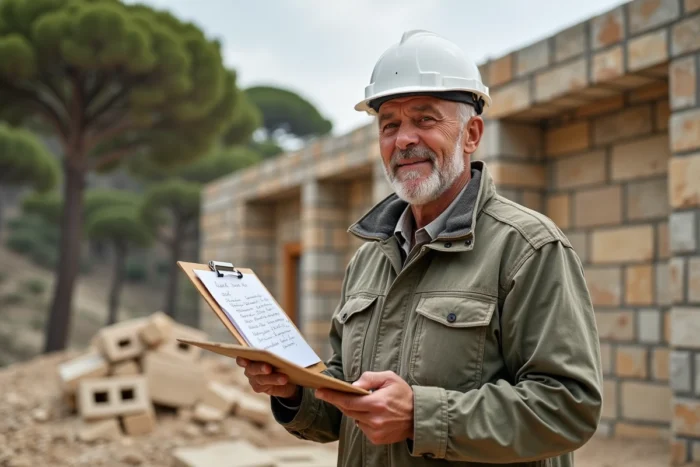
Villa in Cassis and local constraints: what the land imposes on the budget
Cassis has particularities that make each budget estimate more fragile than elsewhere. The limestone soil, common in the area, may require special foundations whose cost only appears after the geotechnical study. The proximity to the Calanques National Park imposes architectural and landscaping constraints that limit choices of materials and volume.
The local urban planning plan adds its own rules: maximum heights, impermeable surfaces, facade colors. A locally established project manager knows these constraints even before the first sketch. They avoid back-and-forth with the permit application, which generates months of delays and additional study costs.
The issue of site access also deserves prior analysis. Some Cassis plots are only accessible via narrow paths that prohibit the passage of standard concrete mixers. The project manager must then plan for pumping or staggered supply, two solutions that increase the structural work costs.
CCMI or project management: two distinct budget logics for a villa
The individual house construction contract (CCMI) offers a pre-agreed price, with a guarantee of delivery at the agreed price and deadlines. Project management, on the other hand, operates in separate lots: the project owner signs directly with each craftsman.
This second formula offers more freedom in choosing companies and materials, but it transfers the financial risk to the individual. In the event of a craftsman’s failure, it is the project owner who must find a replacement and absorb any additional costs. Project management is suitable for custom projects, not for budgets without a safety margin.
For a villa in Cassis with specific features (sea view, landscape integration, regional materials), project management often remains the only viable option. The standard CCMI does not cover this type of program. The key remains the quality of the selected project manager: their ability to provide accurate estimates, anticipate site-related issues, and manage a network of reliable craftsmen in the Marseille area.