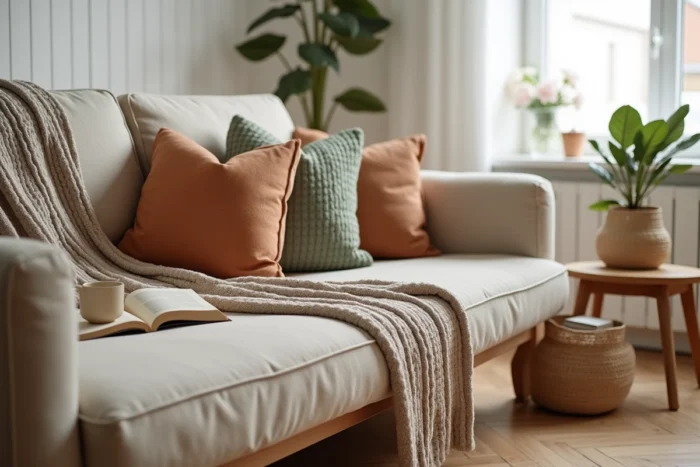
A trendy and comfortable home is based on a simple principle: each room should serve a specific purpose, with materials and colors chosen according to how one lives in it, not just for their appearance. Interior design gains coherence when one first maps out their actual habits before touching the decor.
Cognitive restoration: designing your home as a place for mental recovery
The most significant trend in interior decoration in recent years is not about a color or a material. It concerns cognitive restoration through design: organizing your space to reduce accumulated mental fatigue, especially with remote work.
Specifically, this involves creating micro-zones for decompression. An armchair facing a window, without a screen nearby, is enough to create a recovery corner. The choice of tactile materials (linen, raw wood, boucle wool) contributes to this logic: physical contact with natural surfaces reduces perceived tension.
Useful sorting complements this approach. Reducing the visual load of a room means decreasing the number of micro-decisions the brain processes in the background. Instead of putting everything away in cabinets, one selects objects that remain visible based on their ability to soothe rather than stimulate. Resources like Scooporama’s home page compile several concrete ideas for rethinking your interior from this functional perspective.
Colors and natural light: two interconnected levers for a calming interior atmosphere
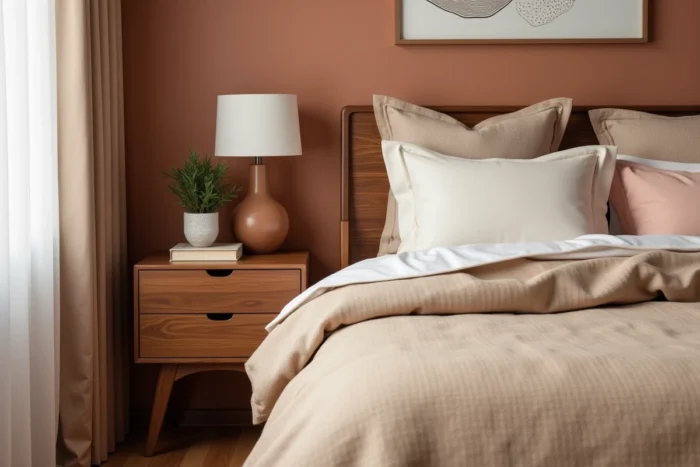
The choice of colors in a home is not solely based on current trends. Color affects the perceived mental load in each room. A bedroom painted in a saturated, bright tone demands more attention than a wall in muted or earthy shades.
For a living room or office, neutral tones (beige, greige, off-white) serve as an adaptable backdrop. Color is introduced in touches, through cushions, a rug, or a frame, allowing the ambiance to evolve without repainting.
Maximizing light to enlarge the space
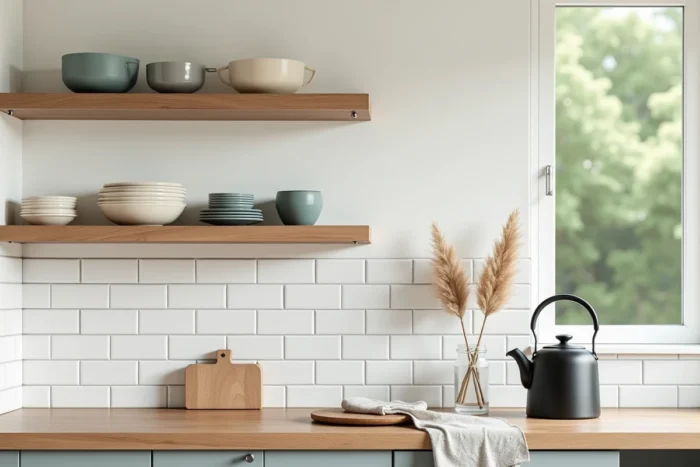
Natural light remains the most underestimated factor in interior design. Before adding light fixtures, one should check that nothing blocks existing openings: overly thick curtains, tall furniture in front of a window, dark paint on the wall receiving light.
Multiplying light sources in a room avoids shadowy areas that visually shrink the space. A three-level lighting setup (ceiling light, reading lamp, string lights or wall sconce) transforms the perception of a living room without changing a single piece of furniture.
Home office layout: separating work and rest in a small space
The home office presents a problem that decor alone cannot solve: the mental contamination between professional and private life. When the office is in the living room or bedroom, the brain never truly disconnects.
The most effective solution is to create a physical boundary, even if symbolic:
- A screen or an open shelf that hides the workspace from the sofa or bed, without blocking the light
- A rug delineating the office area, visually signaling the transition from one use to another
- A closed storage unit (trunk, curtain cabinet) to hide the screen and files at the end of the day
The goal is not to have a decorated office, but an office that fades away. In small spaces, foldable furniture (wall-mounted drop-leaf desk, hanging shelf) allows for the complete removal of any work traces in seconds.
Wood, textiles, and natural materials: a decor trend that also serves thermal comfort
Wood has dominated design trends for several seasons, and this is not just an aesthetic coincidence. Wood, in addition to its warm appearance, contributes to the thermal and acoustic regulation of a room. Solid wood flooring or an oak piece of furniture absorbs some noise and slightly stabilizes the perceived temperature.
Textiles play a complementary role. A living room with a fabric sofa, a wool throw, and a thick rug will be perceived as warmer than an identical living room with smooth, cold surfaces, even at the same temperature. The perceived thermal comfort depends as much on the materials as on the heating.
Combining materials without overloading the room
The most practical rule for a harmonious interior is to limit the types of materials to three per room. For example: light wood, linen, and black metal. Or polished concrete, leather, and ceramics. Beyond three, the eye perceives disorder even if each object is beautiful individually.
For children’s rooms, this logic adapts by favoring washable and durable materials. Raw wood and thick cotton withstand intensive use better than lacquered finishes, which chip and age poorly.
Insulation and overall comfort: thinking of a comprehensive project rather than isolated touch-ups
Improving daily comfort also involves more structural interventions. Since the reform of MaPrimeRénov’, isolated works (changing a window alone, installing a radiator without addressing insulation) are gradually excluded from the aid scheme. Thermal and financial comfort now requires a comprehensive project combining insulation, ventilation, and heating.
This means that before investing in the decor of a cold room, it is better to check the state of the insulation. A thermal curtain or a thick rug partially compensates but does not replace a properly insulated wall. Decor serves as a complement, not a substitute.
Making your home trendy and comfortable means accepting that aesthetics comes last. The most sustainable choices start from usage (how one lives in each room), move through structure (light, insulation, circulation), and end with surface (colors, objects, textiles). An interior that functions in this order remains pleasant well beyond seasonal trends.