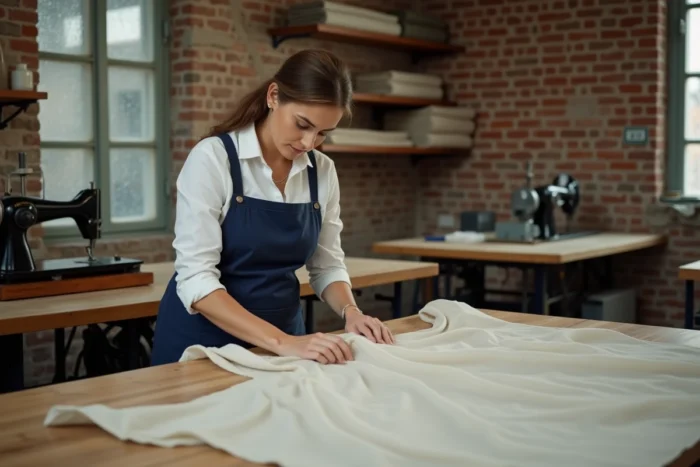
When you turn over a Christine Laure jacket to look at the composition label, you often find “Made in Morocco” or “Made in Tunisia.” The Burgundy-based brand, founded in the 1970s, has built its industrial model around partners located in Eastern Europe and the Maghreb. Understanding where and how these pieces are assembled allows for a better evaluation of what you’re buying, especially in a context where textile transparency is becoming a regulatory requirement.
Logistics and the Gray platform: the nerve center of Christine Laure
Before even discussing manufacturing workshops, we must focus on a link that competitors often overlook: logistics. Christine Laure has historically concentrated its logistics platform in Gray, Haute-Saône. It is from this site that the collections are received, checked, and then redistributed to the network of stores.
This choice of location in Bourgogne-Franche-Comté is not trivial. Proximity to roadways leading to Eastern Europe facilitates the flow of goods from partner workshops. We are talking about a circuit where fabrics can be shipped from France to the manufacturing units and then returned as finished garments to Gray for final quality control.
To better situate the Christine Laure production workshops in this chain, it is important to understand that the Gray platform functions as a filter: each received batch undergoes verification before being dispatched. This centralized operation allows the brand to maintain control over quality despite the geographical dispersion of manufacturing.
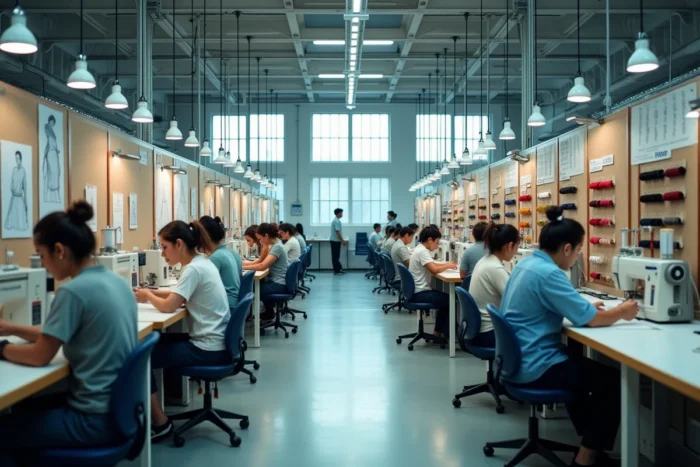
Manufacturing in the Maghreb and Eastern Europe: geographical distribution of workshops
The textile production of Christine Laure relies on a network of partner workshops spread between the Maghreb and Eastern Europe. Morocco and Tunisia account for a significant share of the manufacturing. These two countries have a long-standing textile know-how, skilled labor, and trade agreements with the European Union that facilitate exchanges.
On the Eastern Europe side, countries like Romania and Bulgaria complement the setup. These workshops handle lines that require shorter delivery times to France, given the geographical proximity.
Why so little manufacturing in France
Only a limited portion of production remains on French territory, reserved for the most technical pieces or small series. The cost of manufacturing in France, particularly labor costs and the price of locally sourced raw materials, makes it difficult to achieve competitive mass production for mid-range ready-to-wear.
This nearshoring model (production in nearby countries) is not unique to Christine Laure. The majority of French ready-to-wear brands positioned in this segment adopt the same logic. Returns vary on the consistency of quality between workshops, but the specifications imposed by the brand aim to standardize finishes.
Quality control and specifications: what the brand requires from its suppliers
A workshop does not work for Christine Laure without going through a validation process. The brand imposes a specification that covers several concrete points:
- Raw materials must meet European textile safety standards, particularly the absence of regulated chemical substances (REACH).
- Each stage of manufacturing is subject to repeated audits, focusing on seams, finishes, and colorfastness after washing.
- Working conditions in partner workshops are verified according to social criteria aligned with European standards.
This level of requirement partly explains why the brand limits the number of its suppliers. Working with a restricted network allows for better control of quality discrepancies from one batch to another.

Judicial recovery and impact on Christine Laure’s textile production
Since August 2024, Christine Laure has been engaged in a judicial recovery procedure before the commercial court of Dijon. The gradual closure of stores in France has direct repercussions on the brand’s industrial organization.
Fewer points of sale mean reduced order volumes from partner workshops. Specifically, some suppliers in the Maghreb or Eastern Europe are seeing their Christine Laure order books shrink. The question for loyal consumers is: will upcoming collections be produced under the same quality conditions with lower volumes?
Textile transparency: a legal obligation in preparation
Meanwhile, a French legislative proposal regarding the environmental impact of the textile industry aims to impose clear labeling of the place of manufacture for any textile product sold online. The place of manufacture must be displayed with the same visibility as the price.
For a brand like Christine Laure, which produces in several countries, this obligation will force a precise and public mapping of each workshop. We can expect that online product sheets will soon systematically mention “made in Morocco” or “assembled in Romania,” instead of the current vagueness.
The industrial model of Christine Laure reflects the classic trade-offs of mid-range French ready-to-wear: centralized logistics in France, manufacturing outsourced to nearby countries, and quality control that attempts to compensate for distance. The ongoing judicial recovery procedure and future textile transparency obligations will likely reshape this framework in the coming months.