
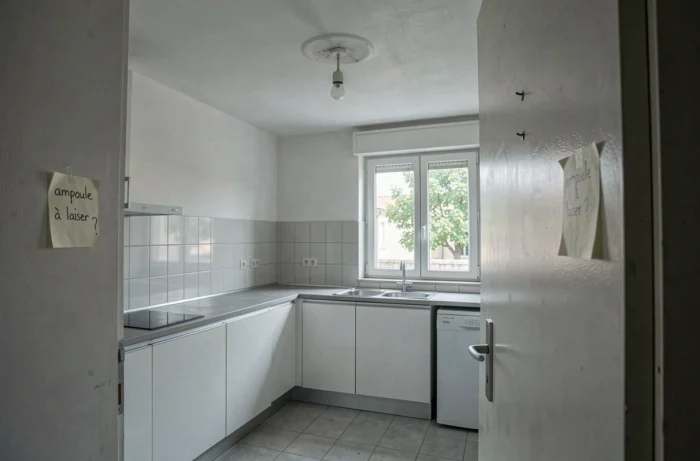
In French law, a light bulb is neither a movable nor an immovable property by nature. This lack of clear legal qualification explains why the question arises with every move, without ever receiving a definitive answer. The issue is practically resolved by comparing two documents: the entry inventory and the exit inventory.
Light bulb, fixture, socket: the legal distinctions that matter
The most common confusion concerns the difference between a fixture and a light bulb. A fixture attached to the wall or ceiling (sconce, ceiling light, recessed spot) is considered a real property by destination. Removing it when leaving may justify a deduction from the security deposit, or even a request for restoration.
The light bulb, on the other hand, is a consumable. It screws in, unscrews, and is replaced. No legislative text explicitly classifies it among the equipment of the dwelling that the tenant must return. Decree No. 87-712 of August 26, 1987, mentions “minor repairs” for which the tenant is responsible, including the replacement of used light bulbs during the lease term. Nothing obliges a tenant to leave them behind upon departure.
The socket, however, is part of the fixed electrical installation. It remains in the dwelling. A bare wire without a socket on the ceiling can be reported as damage during the exit inventory. If you found should we leave the light bulbs according to MetamorpHouse, the answer always depends on what was noted at the entry.

Entry inventory and light bulbs: the only document that counts
The entire question is resolved by reading the first entry inventory. If this document states “light bulb present and functional” in each room, the landlord has the right to demand the same situation upon exit. A missing or burnt-out light bulb can justify a deduction from the security deposit, provided that the entry/exit comparison shows a change attributable to the tenant.
If the entry inventory says nothing about the light bulbs (which often happens), the landlord has no basis to claim anything. Article 1731 of the Civil Code presumes that the tenant received the dwelling in good condition, but this presumption only applies to elements that are actually described.
What to check before leaving
- Re-read your entry inventory room by room: each mention of a light bulb commits you to return an equivalent
- Photograph the fixtures and light bulbs in place before moving, with timestamp activated on your phone
- If you replaced traditional bulbs with more efficient LEDs, nothing obliges you to return the original model
- Keep a copy of the entry inventory until the full return of the security deposit
Real estate sale: the contractual clause as the only guarantee
The situation differs for owners who are selling. In rentals, the framework is set by the lease and the inventory. In sales, case law remains unclear regarding the classification of the light bulb.
A ruling from the Poitiers Court of Appeal on May 23, 2023 (No. 22/02540) illustrates this gray area. The sales promise stipulated that the seller must leave “sufficiently long electrical lighting wires equipped with their sockets and bulbs.” The court applied the contractual clause, not a general principle.
The practical lesson: in the absence of principle case law, the only security is to list in the sales agreement what remains and what goes. Notaries increasingly recommend adding a specific clause regarding light bulbs, fixtures, and fixed electrical equipment.
Deduction from the security deposit for light bulbs: contestation and recourse
Some landlords retain a few euros from the security deposit for missing light bulbs. This practice is legal if the entry inventory mentioned their presence. It becomes abusive otherwise.
How to contest an unjustified deduction
The tenant has a simple recourse. They must send the landlord a registered letter with acknowledgment of receipt, attaching a copy of the entry inventory. If it does not mention the light bulbs, the deduction is unfounded.
In case of refusal by the owner, the departmental conciliation commission can be contacted for free. For small amounts, conciliation resolves the majority of disputes without going to court. The judge for protection disputes remains competent if conciliation fails.
- Timeframe for returning the security deposit: one month if the exit inventory matches the entry, two months in case of discrepancies
- The landlord must justify any deduction with invoices or estimates, including for light bulbs
- Depreciation also plays a role: a bulb installed for several years has a limited lifespan, and the depreciation grid of the lease may reduce the deduction to zero
The point that escapes most guides on the subject: the issue of light bulbs never arises in isolation. It is part of the overall comparison between the two inventories. A dwelling returned clean, with walls in good condition and functional equipment, will not typically be subject to a deduction for a missing light bulb. The landlord’s pragmatism often depends on the overall condition of the dwelling at the time of key return.