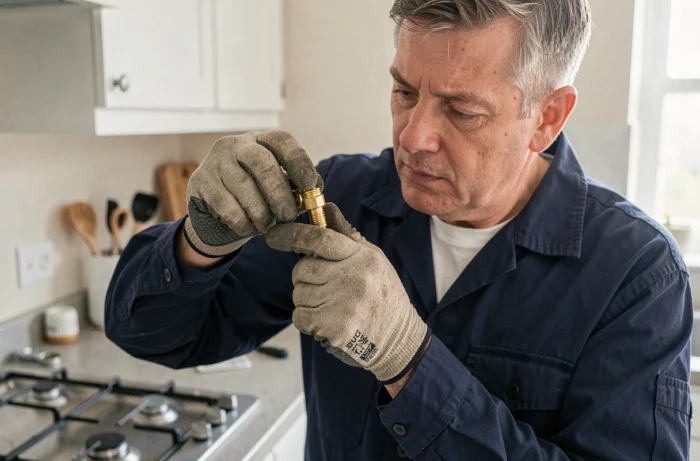
A gas injector is a brass piece with a calibrated orifice that regulates the flow of gas to the burner of a stove or cooktop. The diameter of this orifice, expressed in hundredths of a millimeter, determines the amount of gas that fuels the flame. Installing an unsuitable injector causes incomplete combustion, an unstable flame, and may compromise the appliance’s compliance with the NF EN 30-1-1 standard.
Gas category and injector marking: the link to understand first
Each type of gas has its own service pressure and calorific value. Natural gas (town gas) is distributed under a lower pressure than butane or propane in bottles. To compensate, injectors intended for natural gas have a wider orifice than those designed for bottled gas.
This difference is reflected in a system of standardized markings. Injectors are engraved with a marking: G20 for natural gas, G30 for butane, and G31 for propane. In practice, G30 and G31 injectors often share the same diameter, as these two bottled gases operate with comparable orifices.
A correspondence table for town gas and bottled gas injectors allows for a quick check of the appropriate marking for each burner based on its nominal power and the type of gas connected. This marking is found in the appliance’s manual, typically in a section titled “Injector Table.”
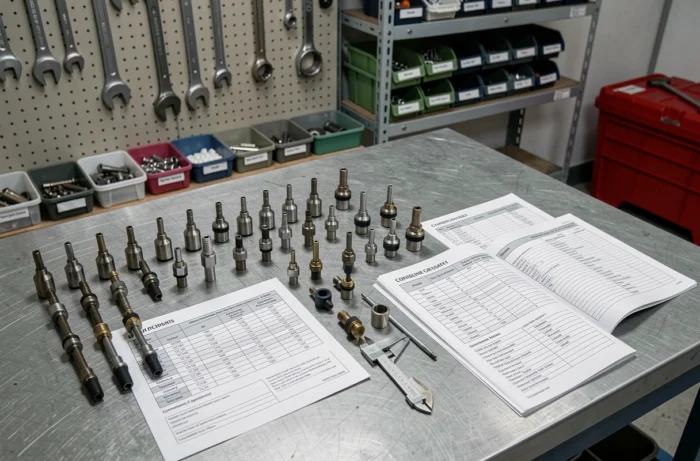
Injector diameter according to burner type
The marking alone is not enough. On the same stove, each burner has a different nominal power, and therefore a specific injector diameter. An auxiliary burner (the smallest flame) does not accept the same injector as a rapid burner or that of the oven.
Common markings by burner and type of gas
| Type of burner | Bottled gas (G30/G31) – marking in 1/100 mm | Natural gas (G20) – marking in 1/100 mm |
|---|---|---|
| Auxiliary burner | 24 to 50 | 24 to 70 |
| Rapid burner | 33 to 87 | 33 to 129 |
| Oven burner | 42 to 90 | 42 to 135 |
Values vary from one manufacturer to another. Those presented here come from a Gorenje stove manual and serve as indicative references. Only your appliance’s manual guarantees the correct size.
The logic remains the same: the higher the burner power, the larger the injector diameter. And for the same power, the G20 injector remains wider than its G30/G31 equivalent.
Conversion from natural gas to bottled gas: the missing kit trap
A move or a change of connection often requires converting an appliance from town gas to butane or propane (or vice versa). This operation requires the complete replacement of injectors, as well as an adjustment of the primary air flow on each burner.
The recent trend among several manufacturers complicates this step. Appliances leave the factory set for natural gas G20, and the injector kit for butane or propane must be ordered separately. This kit is not always supplied with the appliance, which poses two concrete problems:
- The actual cost of conversion includes the purchase of the injector kit and, in most cases, the labor of a qualified professional to perform the change and check for leaks.
- A delivery delay for the kit may lead the user to temporarily use the appliance with the wrong injectors, resulting in a yellow flame, soot deposits, and a risk of carbon monoxide production.
- Without proper intervention, the appliance loses its regulatory compliance with the NF EN 30-1-1 standard, which can be problematic in the event of a disaster covered by home insurance.
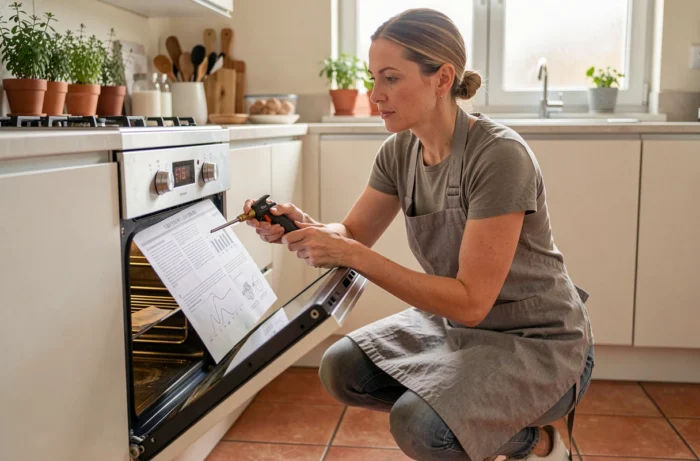
Universal injectors or original injectors: selection criteria
When original injectors are no longer available from the manufacturer, universal injectors represent an alternative. These parts are designed to fit most stoves, regardless of the gas used.
Their threading is standardized, and they cover a wide range of diameters. However, the thread pitch may differ slightly from one brand to another. Before purchasing a universal kit, it is essential to check the diameter of the injector holder’s thread on the appliance.
When to prioritize original parts
On a recent appliance still under warranty, replacing with injectors not referenced by the manufacturer may void the warranty. Original parts guarantee an exact fit for diameter and thread, without the risk of leaks at the connection.
For an older appliance whose spare parts are no longer manufactured, universal injectors remain the most accessible solution. Comparing the marking engraved on the original injector with that of the universal model is the minimal verification step before any installation.
Reading the engraved marking and checking before installation
Each injector has a number engraved on its hexagonal head. This number corresponds to the diameter of the orifice in hundredths of a millimeter. An injector marked “97” therefore has an orifice of 0.97 mm.
To identify the correct injector without a manual, it is necessary to unscrew the existing injector using a suitable tube wrench, read the engraved marking, and then cross-reference it with the type of gas connected. If the marking falls within the range of G20 injectors (wide orifice) and the appliance is to operate on butane or propane, replacement is necessary.
Correct installation requires a firm tightening without excess. A poorly tightened injector causes a gas leak at the burner, detectable by smell or through a soapy water test. After each change, light the burner and observe the flame: it should be blue, stable, and regular. A yellow flame or one that lifts off the crown indicates an unsuitable diameter or an air adjustment issue.